
BRG Analysis - The .amex Use Case

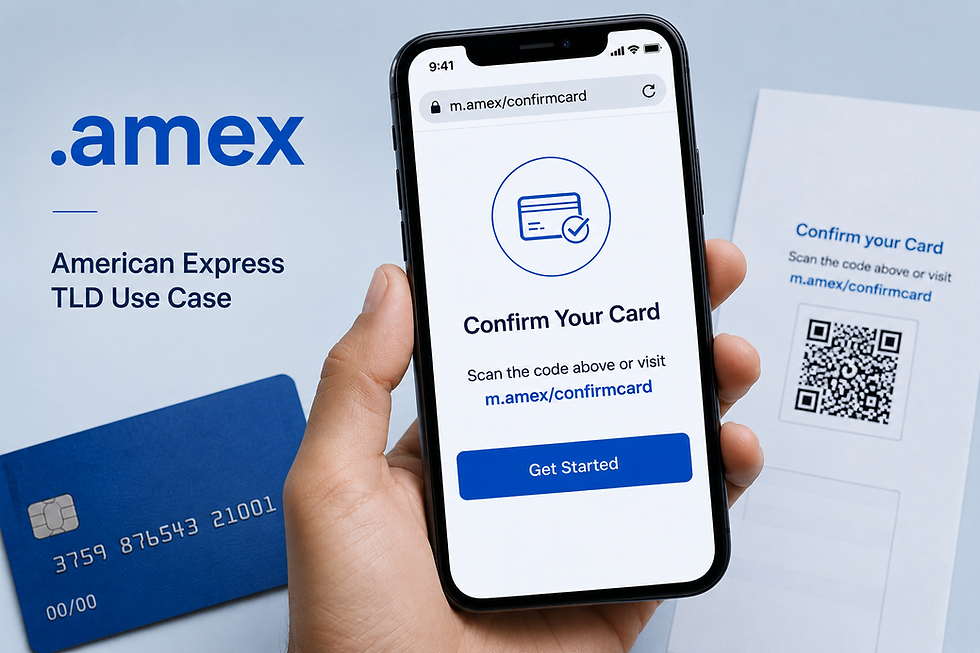
American Express provides a strong example of how a dotBrand TLD can move beyond simple brand protection and become a meaningful part of the customer experience. Through its use of the .amex namespace, particularly in customer onboarding and account activation, AMEX is showing how a branded domain can help build trust, simplify digital interactions, and reinforce brand authenticity.
One example appears in a recent American Express card mailer directing customers to m.amex/confirmcard to activate and confirm their new card. Rather than sending customers to a longer or more traditional URL under .com, AMEX uses a short, highly branded address that feels direct and intentional.
The simplicity of the URL matters. Customers can immediately recognize that the site belongs to American Express because the brand itself is embedded in the domain ending. In an environment where phishing and spoofed websites are increasingly common, that familiarity creates confidence. A customer seeing “.amex” can more easily understand that they are interacting with an official AMEX property.
This becomes especially important in financial services, where trust is central to every customer interaction. Consumers are regularly warned not to click unfamiliar links or enter sensitive information on suspicious websites. DotBrand domains offer a unique advantage because the entire namespace is controlled by the brand owner. Unlike open TLDs, where bad actors can register lookalike domains, only American Express can operate within the .amex ecosystem.
The use of m.amex/confirmcard also demonstrates how dotBrands can improve the customer journey itself. The URL is short, memorable, and optimized for mobile engagement. The mailer pairs the URL with a QR code and messaging around the American Express app, creating a seamless connection between physical communications, mobile experiences, and digital services.
Importantly, AMEX is not using its dotBrand purely as a marketing novelty. The company is integrating .amex into real customer workflows at key moments where trust and usability matter most. That practical deployment is what separates mature dotBrand strategies from more experimental or campaign-driven uses.
The broader implication for dotBrand owners is clear. When brands use their TLDs in customer-facing experiences tied to security, onboarding, authentication, or account management, the domain itself becomes a trust signal. Over time, repeated exposure to these branded environments can help customers develop stronger confidence in legitimate brand communications.
American Express is demonstrating that a dotBrand can function as more than a digital asset. In the case of .amex, it becomes part of the company’s broader strategy around customer trust, security, and brand consistency. The use of m.amex/confirmcard is a simple but effective example of how dotBrands can create clearer and safer pathways between brands and their customers.


Comments